
TTIP - Are We Losing Control?
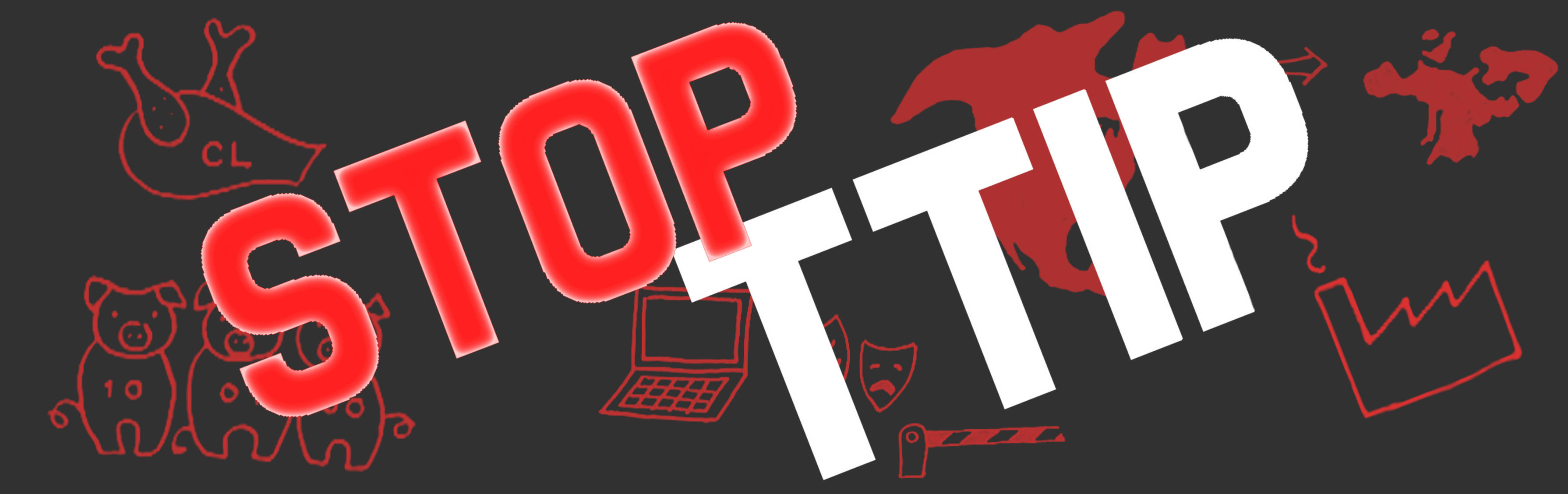
Image courtesy of stopttip.wordpress.com
Love it or hate it, there is no denying we live in a world of ‘clicktivism’. Petitions of all kinds fly around cyberspace, garnering global support for even the most specific, community-driven issues. Many of us wont sign anything that is put on front of us, whilst others subscribe to just about every online activism community that their bandwidth will allow.
The real issue with this is evident: can it make a difference? And the answer is simple: Yes, it can. Whilst it may be absurd to think that clicking a few buttons can have a global impact, the reality is that it can, when used correctly, make a huge difference. This is why I am writing this article – your help is urgently needed.
TTIP & TPP
These two acronyms (that look comically similar to Scotland’s own beloved T in the Park) cleverly hide one of the most important and potentially damaging corporate agreements that we may face in our lifetimes.
TTIP stands for Transatlantic Trade Investment Partnership and refers to an impending agreement between the EU and the US over “free trade”. TTP stands for Trans Pacific Partnership, a similar “free trade” agreement between the US, Canada, Australia, Japan, Peru, Singapore to name a few, which will replace the TPSEP*, which has been in existence since 2005.
* Trans-Pacific Strategic Economic Partnership Agreement
Video courtesy of 38 Degrees
Quick Link: send a comment to the EU Commission asking to review TTIP.
What do these Partnerships entail?
Over the past 5 years, large corporations, banks and government officials from the US and a number of EU countries have been partaking in a series of clandestine meetings to discuss the future of our trade and economy. The TTIP deals are being portrayed as positive developments, and the European Commission website boldly claims it is “designed to drive growth and create jobs” whilst “making trade work for you” – the latter being the Partnership’s catchy slogan.[1] The reality, however, is that the only people these deals will benefit are the banks and large corporations.
Sounds cliché, doesn’t it?
Well, the sad reality is that this cliché is true.
The TTIP will further enable large corporations and banks to control the countries that agree to and sign the deal. Adhering to an agreement like the TTIP or TPP is the first step a government can take in handing over a huge portion of their power – and the peoples’ democratic powers – to the corporations and banks.
The press and opposing environmental groups and charities have been prevented from attending these conferences. It has gradually become clear that the only voices that will be permitted to speak at both the TTIP and TTP conferences have, thus far, been those of corporate lobbyists and investment bankers.[2] This is direct opposition to our apparently democratic society, in which the actions of our governments should be transparent and rightfully under the scrutiny of the tax-paying and voting public. We are being stripped of our already limited control. We have been given no chance to digest the potential implications of the TTIP, nor have we been offered the opportunity to approve or oppose such a deal. This is not democracy.
How will it affect us?
One of the main deals included in the TTIP is the ISDS – the Investor-to-State Dispute Settlement. This will give corporations the right to sue anyone – including our governments – who facilitates a social or political change that does not agree with their sales contracts or marketing strategy. If a new law were deemed to affect the sales of a corporation, then its investors would have the right to sue those responsible for passing said law. This means that if our Prime Minister decided to phase out nuclear energy or oppose fracking, then the energy firms involved would have a legal right to sue our country for the amount they claim to be losing out on as a result of the new legislation.
When our government get’s sued, who pays? We do, of course. But these deals are being made behind closed doors, and we are not being consulted on the matter. How is this fair that we pay for something we have no say in?
Where is the Evidence?
As I am typing this, I am becoming more and more aware of how fantastical and exaggerated the potential implications of the TTIP could come across. It all sounds like the plot to a Marvel super-villain comic. In fact, this is probably one of the agreements best tools – it seems too crazy to be true. But this is reality.
The sad fact is that other countries have already been affected by similar international trade deals:
- In 2012, the residents of Ottawa actively voted against fracking for oil taking place in Canadian. The residents, however, were unaware that prior to this, the Canadian government had signed up to NAFTA – The North American Free Trade Agreement, which regulates trade between the US, Canada and Mexico and operates under the guise of streamlining trade and economic exchange between the 3 signatories.The NAFTA agreement allowed a US-based Fracking company, Lone Pipe Resources, to file a lawsuit against the Canadian government (and subsequently the tax-payers) a grand total of $250 million (US) – the apparent loses the Lone Pipe claimed to lose as a result of the ban on fracking. [3]
- In 2011, Australia introduced ‘plain packaging’ laws, preventing tobacco companies from using their brands and logos on cigarette packets and forcing the inclusion of large, graphic warning messages against the dangers of smoking. Philip Morris Asia, the Asian branch of one of America’s largest tobacco giants, filed a lawsuit against the Australian government – a move supported by the BIT - Bilateral Investment Treaty - which regulates the country’s trade with Hong Kong. [4]
- Following Japan’s Fukishima disaster in 2011, the German government began phasing out Nuclear Power as a source of energy amidst fears of the widespread environmental effects of a potential meltdown. RWE, Eon and Vattenfall are three of the largest nuclear energy contractors in the world, and all three expressed distaste for the German government’s decision. Vattenfall moved to ‘international arbitration’ – a form of settling huge financial disputes through analyzing contracts and legal agreements, rather than assessing the current socio-political climate, popular opinion and potential environmental dangers – and filed a lawsuit of €1 billion against the German government. [5]
If the TTIP agreement is signed, then companies like Vattenfall and Lone Pipe will have the legal right to sue European governments, effectively us, for doing anything that slightly infringes on contracts they have signed. Whilst this may appear fair – a contract is a contract after all – it totally negates the potentially damaging side effects that those contracts could have.
Imagine this – a large chemical company signs a contract with our government to spray a seemingly safe pesticide over our farmland until the year 2020. By 2015 the ecosystems around the farmlands are massively affected - animals and plants die and some of our rivers become contaminated. If we were to successfully sign and send a petition to our government forcing them to stop the pesticide distribution, then that large chemical company could sue our country for the amount they would have made had it continued until the originally agreed date in 2020.
The proposed ISDS plan is only one of the many potentially harmful effects that the TTIP could have on our quality of life. Government decisions to raise minimum wage could result in lawsuits from employer firms unhappy with the forced pay increase and US food giants could use the agreement to lobby against EU countries to change food laws prohibiting GM crops and cloning hormonally treated livestock to meet the higher food demands required by the Partnership. [6]
What can we do to stop TTIP?
Beginning on 14th July 2014[7] , the European Commission will host EU-US trade talks in Brussels to decide on the TTIP. Due to an influx of campaigning from all over Europe, there is currently a consultation being held with regards to the inclusion of ISDS in the deal. Whilst it does not stop the whole TTIP agreement, we can prevent the ISDS from affecting our right to have control over our own livelihoods. This consultation closes on Saturday 5th meaning we have only hours to act.
This EU Commission consultation does not work like other government talks – unfortunately putting our names to a petition will not do, nor will sending a generic cover letter provided by 38 Degrees or SumOfUs. Rather, we are required to write our own short email to the EU Commission, pleading that the ISDS’s inclusion in the TTIP be reconsidered. This email does not have to be huge, nor referenced – just a statement to say that you care about your rights and that the ISDS could damage this.
Go here to send your email.
*NOTE*
A few people tried to submit emails to the EU Commission via the 38 Degrees Website on Thursday 3rd July. The emails were rejected and attributed to an error in the website’s Captcha anti-spam system. I hope this is the outcome of the thousands of letters being sent from all over Europe, and not something more sinister.
*UPDATE*
38 Degrees released an email stating that their lawyers have managed to convince the EU Commission to reopen the submission page. The link now works again.
This video from 38 Degrees is great for inspiration on what aspects of the Partnership you might want to focus on in your letter.
More info: http://stopttip.net
TPP
We don’t need to stop at TTIP. We can help on a global scale by aiding this SumOfUs campaign in opposition of new plans to expand the TPP’s reach to 12 countries and tighten its control over the signatories. Proposed legislations will heavily affect copyright and intellectual property laws, as well as making jailbreaking your Smartphone punishable my law. [8]
The TPP conferences were scheduled to take place in Vancouver, Canada from 3rd – 12th July.[9] SumOfUs (among other charities, campaigners and smaller business owners) had arranged for a huge protest to await the TPP conference, and organised for non-corporate lobbyists and environmental experts to be present at the talks.
However, the TPP has conference moved – unannounced – to Ottawa in order to avoid pressure from the campaigners[10]. This is a five hour long plane journey across Canada, and could hugely affect the ability of charities, campaigners and concerned business owners to represent their opinions at this hugely important TPP conference. The conference is currently underway, but there is still time to help transport the campaigners, who have spent so much time and money flying to Vancouver, over to Ottawa to participate in the following week’s talks. By donating just £1, you could help represent the views of the people – not just the banks and corporations – at this crucial moment in history.
Donate £1 to SumOfUs here
Words by Marco Biagini
References
[1] EU Commission Website: http://ec.europa.eu/trade/policy/in-focus/ttip/
[2] What’s Wrong with TTP: https://www.eff.org/issues/tpp
[3] Lone Pipe Resrouces Files Outrageous Lawsuit Against Fracking Ban: http://content.sierraclub.org/press-releases/2013/10/lone-pine-resources-files-outrageous-nafta-lawsuit-against-fracking-ban
[4] Philip Morris, Australia and the Fate of Europe’s Trade Talks: http://inside.org.au/philip-morris-australia-and-the-fate-of-europes-trade-talks/
[5] Vattenfall vs Germany: http://www.spiegel.de/international/germany/vattenfall-vs-germany-nuclear-phase-out-faces-billion-euro-lawsuit-a-795466.html
[6] 10 Reasons TTIP is bad for Good Food and Farming: http://www.iatp.org/documents/10-reasons-ttip-is-bad-for-good-food-and-farming
[7] EU Commission: http://trade.ec.europa.eu/doclib/press/index.cfm?id=1093
[8] What’s Wrong with TPP: https://www.eff.org/deeplinks/2012/08/whats-wrong-tpp
[9] TPP chief negotiators coming to Vancouver in July: http://www.ipolitics.ca/2014/06/12/tpp-chief-negotiators-coming-to-vancouver-in-july
[10] TPP Meeting Switched from Vancouver to Ottawa: http://boingboing.net/2014/07/02/trans-pacific-partnership-meet.html